
The Trip That Changed Malcolm X's Legacy
On his birthday week, remembering what has made Malcolm such an enduring icon

This week marks the 101st anniversary of Malcolm X’s birth, and his daughter Ilyasah Shabazz is celebrating the milestone with a new book, Malcolm in the Desert, focusing on her father’s historic 1964 trip to Africa and the Middle East, including his first pilgrimage to Mecca. In her book tour appearances, Ilyasah has rightly stressed how that journey in the last year of Malcolm’s life reflected who he was at his core: a deep searcher whose extraordinary odyssey from prison to pulpit to world traveler, which millions of readers know from The Autobiography of Malcolm X, was always as much spiritual as it was political. Yet as I show in my book The Afterlife of Malcolm X (out in paperback next month), the journey should also be remembered for the way it reshaped how Malcolm would be viewed by posterity.
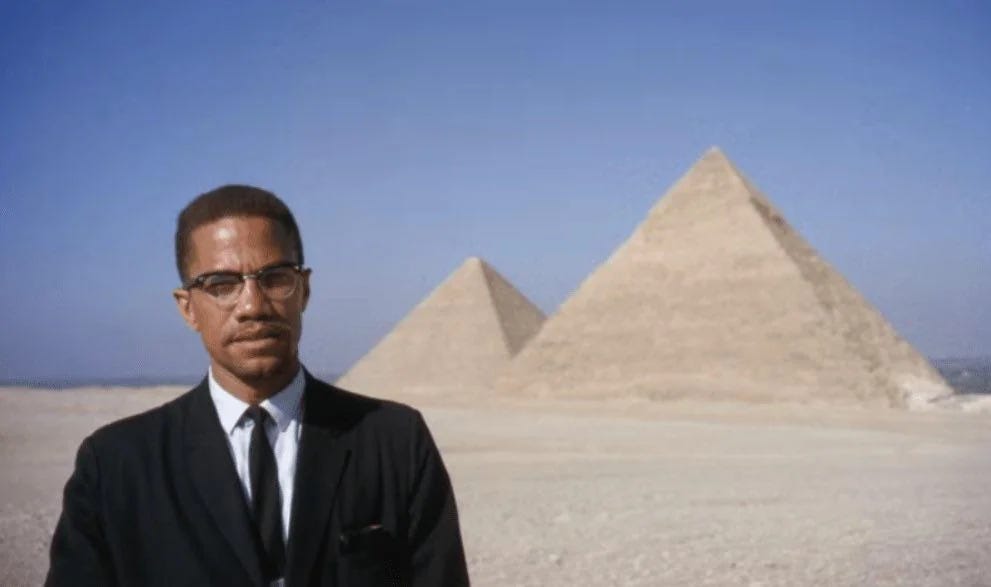
Malcolm embarked on the trip, which also included a tour of the pyramids and visits with several African heads of state, only weeks after officially splitting from the Nation of Islam and its leader Elijah Muhammad. For a decade, Malcolm had been the NOI’s chief spokesman and the person most responsible for making white Americans aware of its gospel of racial separatism. Behind the scenes, however, Malcolm had grown increasingly disillusioned with Muhammad. He had discovered that the NOI leader had secretly fathered out-of-wedlock children with a series of female assistants, then allowed those women to be punished with temporary bans for sexual impropriety. Malcolm also balked at the NOI’s reluctance to participate in the civil rights movement (so as not to endanger its tax-exempt status), a frustration Malcolm showed by quietly attending the 1963 March on Washington. Now, freed from obedience to the NOI, Malcolm began to defy the company line on both fronts: telling Mike Wallace of CBS News and other reporters about Elijah Muhammad’s infidelities; and seeking a photo-op with Martin Luther King Jr. when both men attended a hearing on the 1964 Civil Rights Bill on Capitol Hill.
It was the voyage overseas, however, that provided Malcolm with the opportunity to make a third and even more consequential break with NOI gospel: repudiating Elijah Muhammad’s teaching that white people were inherently evil “blue-eyed” devils. After making “Hajj” to Mecca along with orthodox Muslims from around the world, Malcolm wrote these words in a long letter to associates that he scribbled in blue ink on stationery illustrated with drawings of the Islamic holy city:
“Throughout my travels in the Muslim world, I have met, talked to, and even eaten with people who in America would have considered ‘white’— but the ‘white’ attitude was removed from their minds by the religion of Islam. I have never before seen sincere and true brotherhood practiced by all colors together, irrespective of their color. You may be shocked by these words coming from me. But on this pilgrimage, what I have seen, and experienced, has forced me to re-arrange much of my thought patterns previously held, and to toss aside some of my previous conclusions. This was not too difficult for me. Despite my firm convictions, I have always been a man who tries to face facts, and to accept the reality of life as new experiences and new knowledge unfolds it. I have always kept an open mind, which is necessary to the flexibility that must go hand in hand with every form of intelligent search for truth. During the past eleven days here in the Muslim world, I have eaten from the same plate, drunk from the same glass, and slept in the same bed, (or on the same rug)—while praying to the same God—with fellow Muslims, whose eyes were the bluest of blue, whose hair was the blondest of blond, and whose skin was the whitest of white.”
It was a frank and eloquent about-face—and meant just as much for white media consumption as for his Black followers. In the years before his break with the NOI, Malcolm had quietly cultivated relationships with a handful of sympathetic white reporters, one of whom was M.S. “Mike” Handler, a veteran war and civil rights correspondent for the New York Times. Through intermediaries, Malcolm arranged to have a copy of his letter shared with Handler, who wrote a story about it for the front page of the Times. So when Malcolm returned to the United States two weeks later, follow-up press coverage focused on his new view of white people and his willingness to change his mind.
To be sure, Malcolm hadn’t suddenly become a racial moderate. He continued to call out overt white racists and hypocritical white liberals, and to push for African countries to condemn America’s mistreatment of its Black citizens at the United Nations. But Malcolm’s trip and that letter were the beginning of a public recasting of his image, from strident racial nationalist to globe-trotting fighter for international human rights.
At a time when hard-won freedoms are under fierce assault again, Malcolm’s 1964 pivot offers three lessons for leaders who aspire to follow in his footsteps. One is the necessity of seeking alliances in the ongoing struggle for racial equality—and to safeguard other endangered rights. A second is the necessity for shrewd communication—not only in the content of messaging, but also in the tactics and timing of its dissemination. And a third, even in this era of shameless dishonesty and hype, is the power of owning up to past mistakes and exhibiting personal growth in demonstrating authenticity and establishing lasting trust. Less than ten months before his brutal assassination, Malcolm’s ability to face those particular facts changed the way he was perceived in the brief time he had left—and set the stage for him becoming an even greater icon and hero in the six decades since.