
Black Golf Joy
Why those of us who play love the game, and the lessons it teaches

Like a lot of tales of Black life in America, this one starts in a barbershop. One thing I appreciate about my favorite neighborhood barbers in New York City, along with the fact that they know how to cut my kinky hair, is that they keep a random assortment of old magazines around to read while I’m waiting for my turn in the chair. The other day, I was doing just that when I picked up a copy of Golf Digest, which I’ve long read as a veteran magazine guy and an occasional contributor. Although the issue in question was over a year old, I hadn’t caught it in print. So I started flipping through the pages, and I was delighted to find an article by Shonda Rhimes—the legendary TV producer and creator of such hits shows as Grey’s Anatomy, Scandal, and Bridgerton—about how she fell in love with the golf.
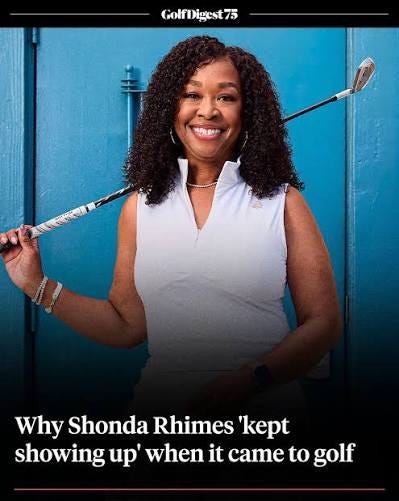
The link is here, but in case you run into a paywall, this was Shonda’s story. She grew up thinking of golf as a sport for rich white people, which deliberately kept out Black folks and women like her. But at some point, her daughter expressed an interest in learning the sport, and Shonda couldn’t say no. So she invested in lessons for her kid, and figured that as a supportive parent she’d try her hand, too, with the thought that they might enjoy playing together. Soon enough, her daughter tired of golf, but Shonda was hooked. She then did a particularly evocative job of explaining what makes golf so addictive, especially for a certain kind of competitive, Type-A personality. It’s not just the time away from the daily grind on pretty golf courses, but the humbling challenge of trying to get better at a game that has utter disregard for how much success you may had in other parts of your life.
The piece took me back to my own experience taking up golf three decades ago. I had grown up listening to my father share indignant memories of earning pocket money by shagging balls on the practice range at an all-white country club in his home town of Pittsburgh where he wasn’t allowed near the clubhouse. But by my mid-thirties, I was a rising editor at Newsweek magazine, and I was being invited to events where everyone played golf: retreats for advertising clients where I was asked to talk about political news, and an annual parent company gathering where golf was one of the afternoon bonding activities. So I figured I should give the game a try, and like Shonda was I quickly hooked despite being a struggling novice.
Still, my sense of racial unease lingered—until one day on a public golf course during my first summer after taking up the game. I was on vacation in upstate New York and going alone to a small nine-hole track in the city of Kingston. One day, as I was about to tee off, an elderly black man approached, also a single, and asked if he could join me. I cheerfully agreed, and after we hit our tee shots and were walking down the fairway, I started asking questions.
Did he live nearby?
Yes, he traveled a lot but had a house in the area.
What did he do for a living?
He was a musician.
What kind of music?
Jazz.
Now he had my attention, since I’m a huge jazz fan.
What was his instrument?
Drums.
All of a sudden, I had a premonition of who the man might be, since I had read somewhere that he had a residence in a nearby town.
Are you Jimmy Cobb?
Yes, that’s me.
Wow! I said. I’m a big fan!
We proceeded to enjoy a lovely round, and Jimmy was as friendly and humble as could be. (He also had a pretty rhythmic swing, as you might imagine.) But beyond meeting one of my jazz heroes—the drummer on Kind of Blue, the most famous jazz album of all time—the encounter completely cured me of my qualms about golf. If Jimmy Cobb played, I had nothing to feel ashamed of.
That same summer, an eighteen-year-old named Tiger Woods won his first of three straight U.S. Amateur championships before turning pro. Tiger-mania was soon in full force, transforming the image and popularity of golf and making millions of Black folks eager and proud to play the sport. Once I started writing books about Black history, I also discovered a long and less covered trail of passion for golf. In my book Smoketown, about the legacy of the Black community of Pittsburgh, I wrote about how golf was introduced to a pre-Tiger generation by Joe Louis, whose exploits as both a professional boxer and a devoted duffer were covered obsessively by the Pittsburgh Courier, then the country’s most widely-read Black newspaper. As I researched Malcolm X’s influence on hip hop for my book The Afterlife of Malcolm X, I kept coming across loving tributes to the game, in lyrics and on social media, from star rappers and MCs all the way from Chuck D and Favor Flav of Public Enemy, to J-Z, Lil Wayne, and Megan Thee Stallion.
In my own life, golf opened the door to hundreds of fascinating new acquaintances, scores of lasting friendships, and a way to get to know professional colleagues and social friends who played even better than I would have otherwise. The Black golfers I’ve met range from cops and firemen, military veterans, and friendly couples with whom I’ve been paired on public courses, to finance executives who have invited me to play at some of the finest private clubs in the country. (One even generously sponsored me for a club membership.) I’ve become close friends with one of our most prolific golf journalists and historians, and had the pleasure of sharing a round with a retired oil company executive who pulled off the amazing feat of playing all of the top 100 golf courses in America in one year, and wrote a terrific book about it.
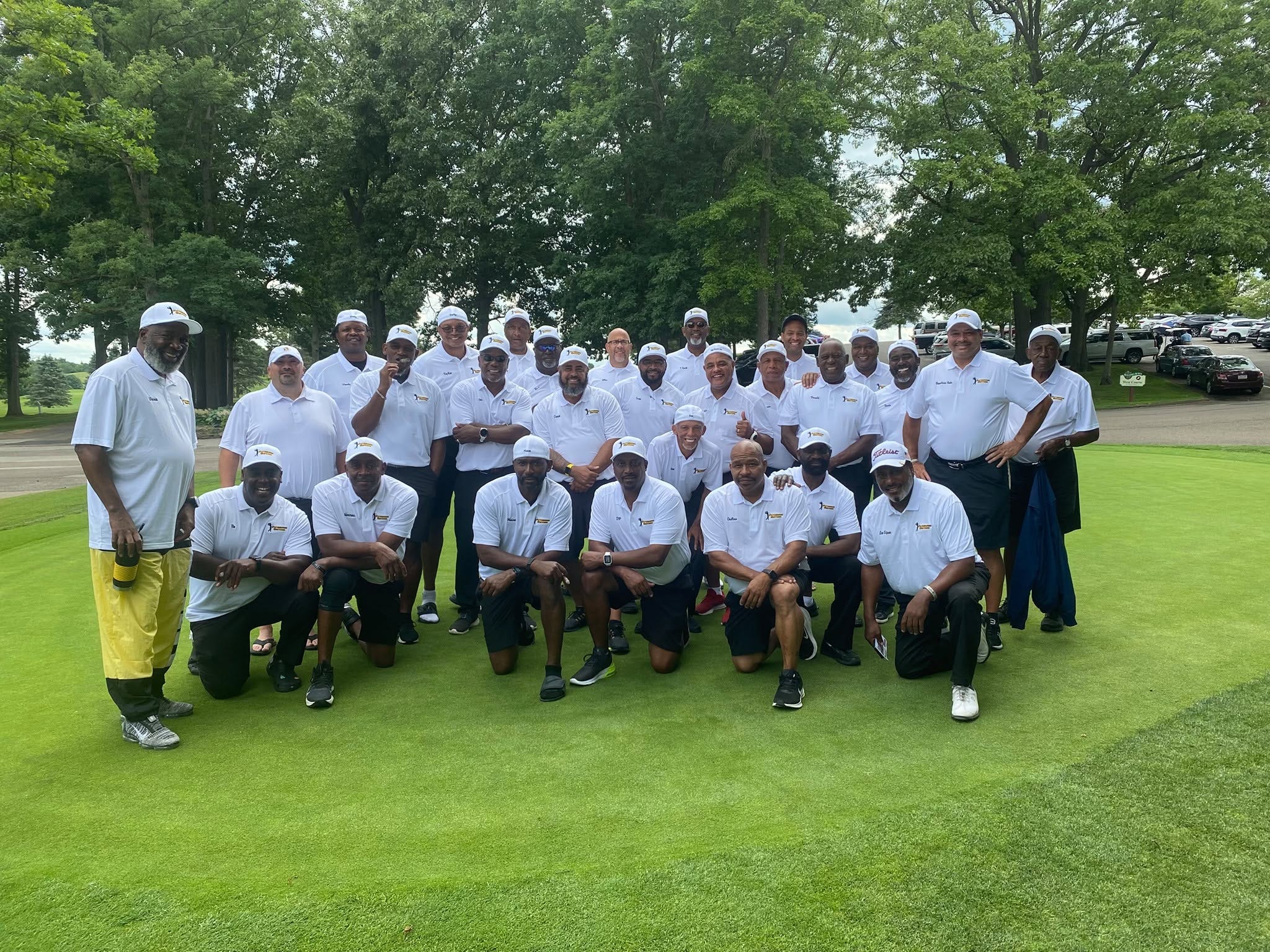
For Golf Digest, I profiled the Pittsburgh Duffers (pictured above), a self-formed weekend traveling club that over the years has integrated dozens of public courses in western Pennsylvania and eastern Ohio. For the same piece, I interviewed Eric and Cecile Springer, a lovely couple who were recruited as the first Black members of Oakmont Country Club at a time when remaining all-white might have endangered that fabled institution’s eligibility to host major tournaments.
As Eric and Cecile told it, they felt an immediate advantage even as newcomers to Oakmont, because as Black business and community leaders they had so much experience exhibiting curiosity and good humor toward people who were different from them. For golf is unique in that respect, too: it regularly invites, and even requires, interacting with people you haven’t met before, and keeps you in their company for four hours or more. So every time I see Black faces on a golf course, I feel a common sense of pride in the gumption that it took for them to embrace this crazy sport. But I also know that, no matter their skill level at golf, they’re likely to be pretty good at a social game that couldn’t be more valuable in these fractious times.
Once again, you knocked the balata cover off the ball. Thank you for finding what's good in people and the best part of the game.
Great piece! I'm still smiling, and I am not a golfer.